Art Therapy and Mindfulness
Art Therapy and Mindfulness
Jan 19
Written By Kenley Turner
For those of you who don’t know, I am in Grad School studying counseling and art therapy at Antioch University. That may be why I’ve been AFK for a bit… I’ve spent a lot of time researching the relationship between art therapy and mindfulness, and would like to self publish my foundational statement on my blog :)
DISCLAIMER: I am a STUDENT just STUDYING art therapy at the time this is published. I am not an art therapist, licensed, or practicing. ENJOY!
For those of you who don’t know, I am in Grad School studying counseling and art therapy at Antioch University. That may be why I’ve been AFK for a bit… I’ve spent a lot of time researching the relationship between art therapy and mindfulness, and would like to self publish my foundational statement on my blog :)
DISCLAIMER: I am a STUDENT just STUDYING art therapy at the time this is published. I am not an art therapist, licensed, or practicing. ENJOY!
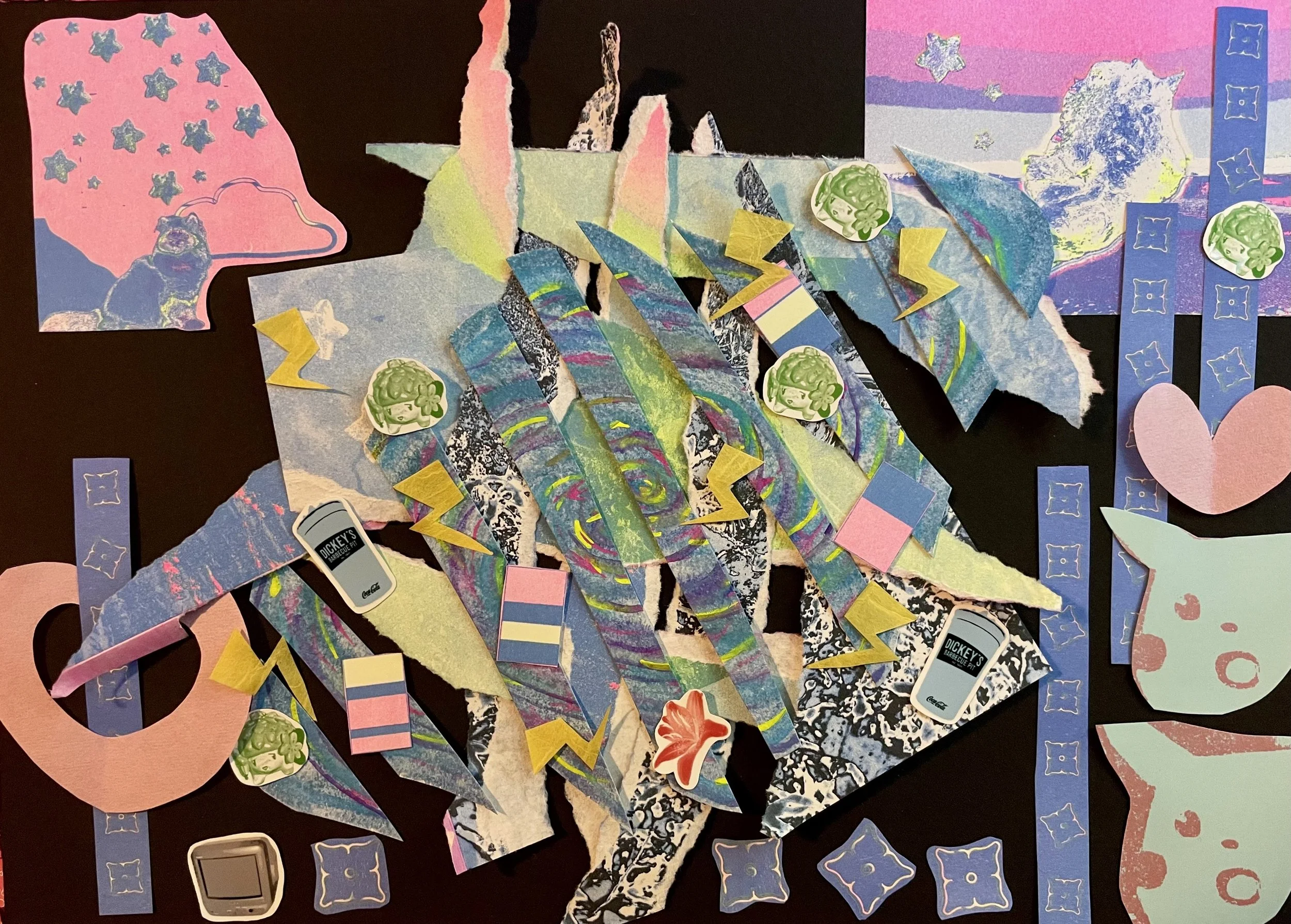
Strengths Collage, 2025
Art, Mindfulness, and Meditation
Art is important to human development and treatment because of its ability to connect an individual to their body. Activating the body and senses is often associated with obtaining a flow state often akin to meditation practices.(Clark, 2017) Engaging with the body and the environment on a purely sensory and kinesthetic level lets people take part in mindfulness, a technique that promotes well being, emotional regulation, and connecting to the present moment. (Hinz, 2019). The perceptual nature of art, such as textures, shapes, and colors help the artist obtain an acute awareness of their surroundings and experience when portraying their environment. The consciousness that the artist is able to obtain through making is a way that mindfulness and its benefits can be achieved, especially when regularly exercised.
Bringing attention to the psychosomatic link is also an integral part of many people’s healing process. Trauma’s damaging effect on the neural system has a physical outcome on the body. Kinesthetic and sensory processing channeled through art is an accessible way to deactivate the destructive brain networks aroused by traumatic experiences. (King, 2024)
Art is a visual language that is a way to convey one’s personal reality, metaphors, problem solving, and amorphous emotion. The ability to hone creativity to express these things and find externalization bring a great deal of realization for the artist to find meaning in their life. (Malchiodi, 2015) This is an ability that can be obtained by anyone, as it is intrinsic to the human experience. It is the art therapist’s job to help the artist break down social constructs that have deterred them from tapping into this ability. (Hinz, 2017) The ways in which people express and create are expanding by the day, making the world of expressive therapy to be a very expansive and exciting place to explore.
References
Clark, S. M. (2017). DBT-informed art therapy : mindfulness, cognitive behavior therapy, and the creative process. Jessica Kingsley Publishers. https://search.ebscohost.com/login.aspx?direct=true&scope=site&db=nlebk&db=nlabk&AN=1340653
Hinz, L. D. (2017). The Ethics of Art Therapy: Promoting Creativity as a Force for Positive Change. Art Therapy, 34(3), 142–145. https://doi-org.antioch.idm.oclc.org/10.1080/07421656.2017.1343073
King, J.L., & Strang, C.E. (Eds.). (2024). Art Therapy and the Neuroscience of Trauma: Theoretical and Practical Perspectives (2nd ed.). Routledge. https://doi-org.antioch.idm.oclc.org/10.4324/9781003348207
Malchiodi, Cathy A. (2015). Creative Interventions with Traumatized Children (Second edition). The Guilford Press.