Radials
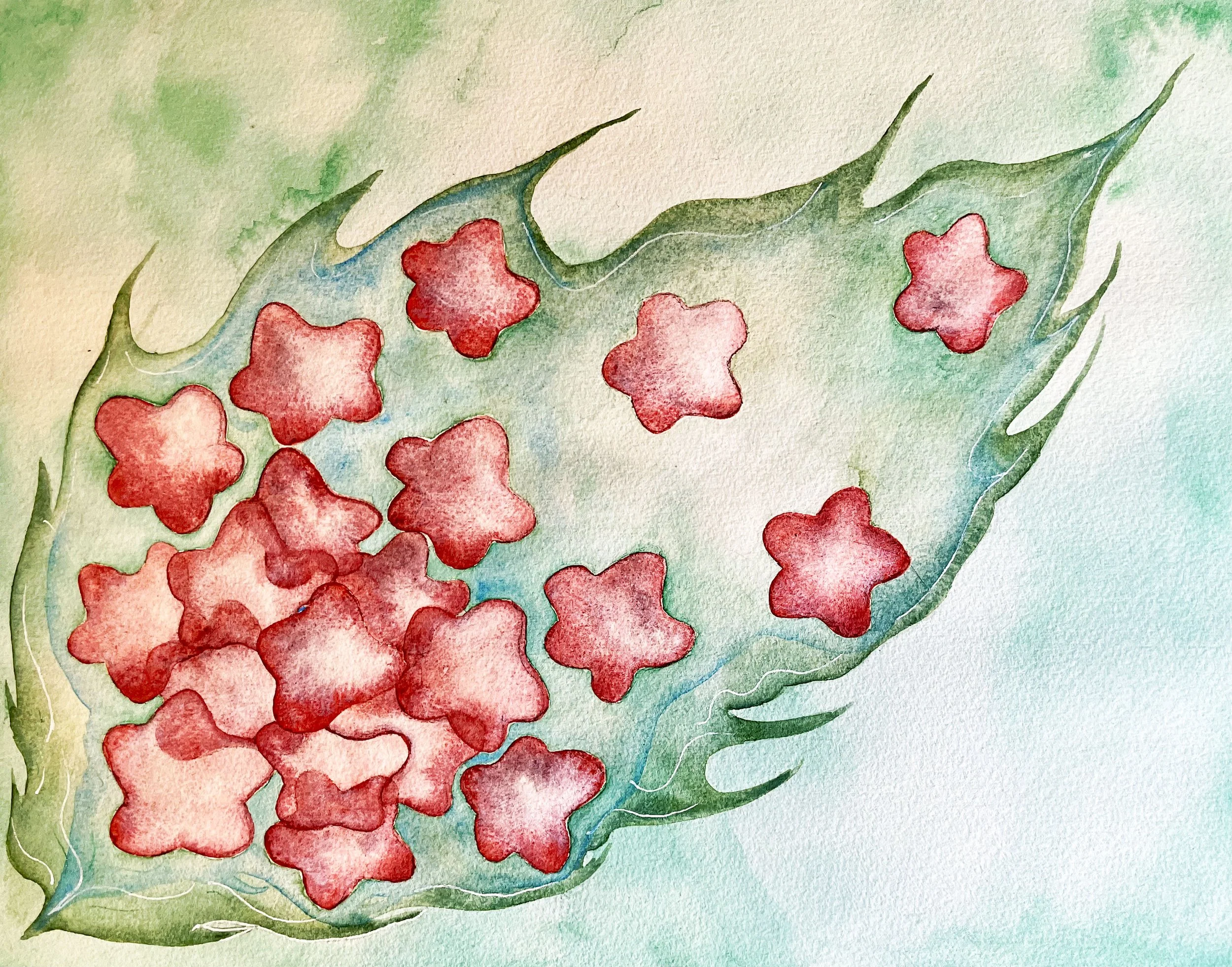
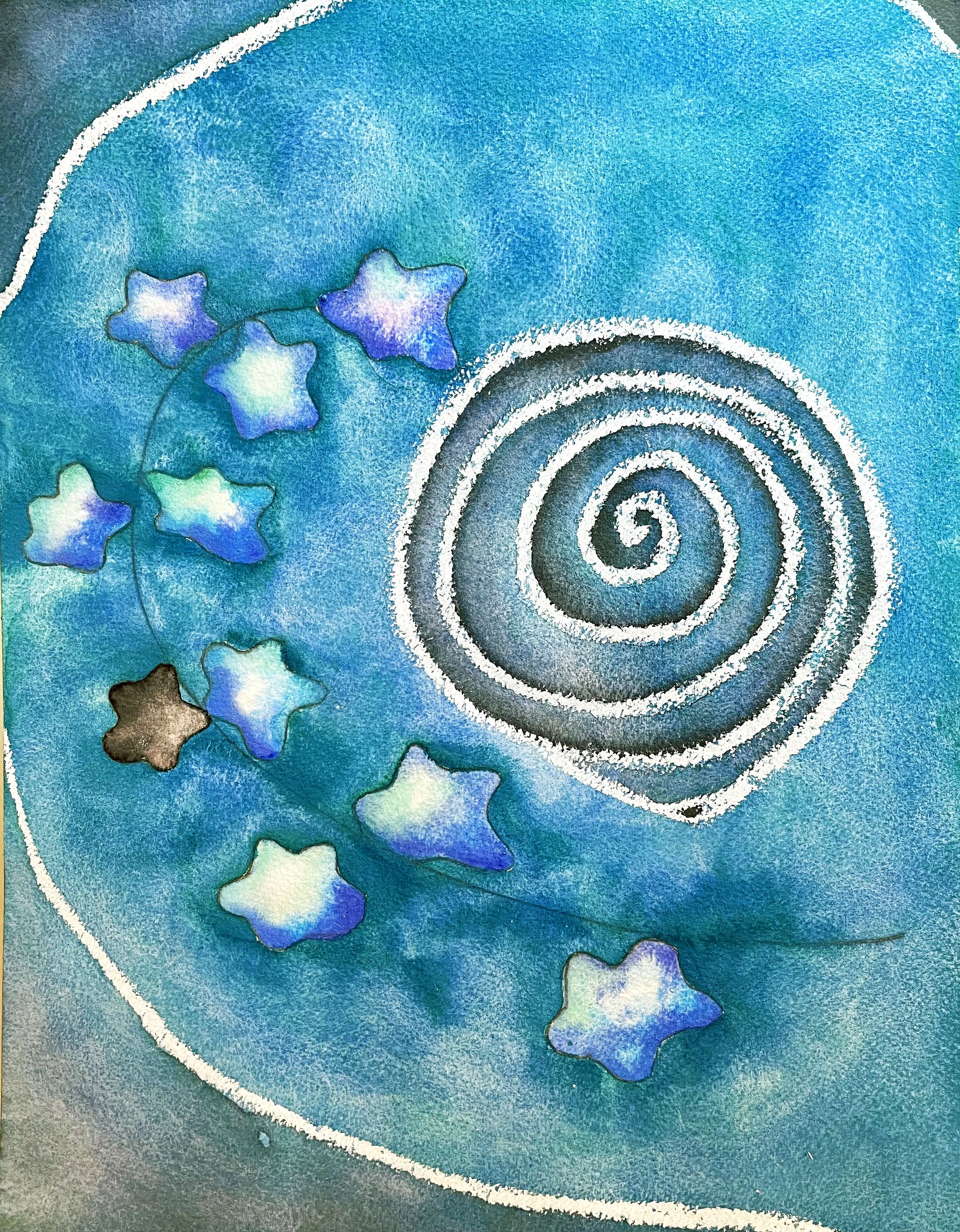
This semester, my learning has informed my personal art practice by shifting importance to the act of making itself rather than the finished product. The ritualistic creation of radial watercolor forms removes personal blocks of what I should make, maintaining the physical process of creation without having pressure of knowing what images to produce. Emphasizing sensory and kinesthetic components such as manipulating water and colors minimizes personal judgements, and energy can be focused on creation.
The repetitive nature of the process has promoted a more prolific art practice, which has led me to the benefits of making more often, including slowing down, centering myself in the present moment, emotional regulation, and therefore, enjoyment. Previously, my relationship to art involved self depreciation and negative thought spirals if I was not yielding large quantities of work because of social factors like comparison or unintentionally subscribing my art practice to capitalistic ideologies. Over contemplating how the art would be received bypassed what the art did for me. This semester, I’ve forced myself to reshape my artistic biases in order to make my eye to see art through a therapeutic lens, which in turn has allowed me to deepen my understanding of what art making does for me at every step.
My relationship to art has benefitted so much from this program because I have pushed myself to be free to make stuff unconditionally. Placing significance on process rather than product has translated as a metaphor for other areas of my life as well, as I grapple with mindfulness and being present in a culture that wants you to always be at your next destination rather than being content in the journey. I think about the privileges I have that make it to where I can spend a couple hours in my house painting each week, and it helps me release myself from the creative constraints I’ve struggled with. Ultimately, I just feel lucky that I get to do this. The gratitude helps me meet my practice with peace.
Star Cluster, 2025
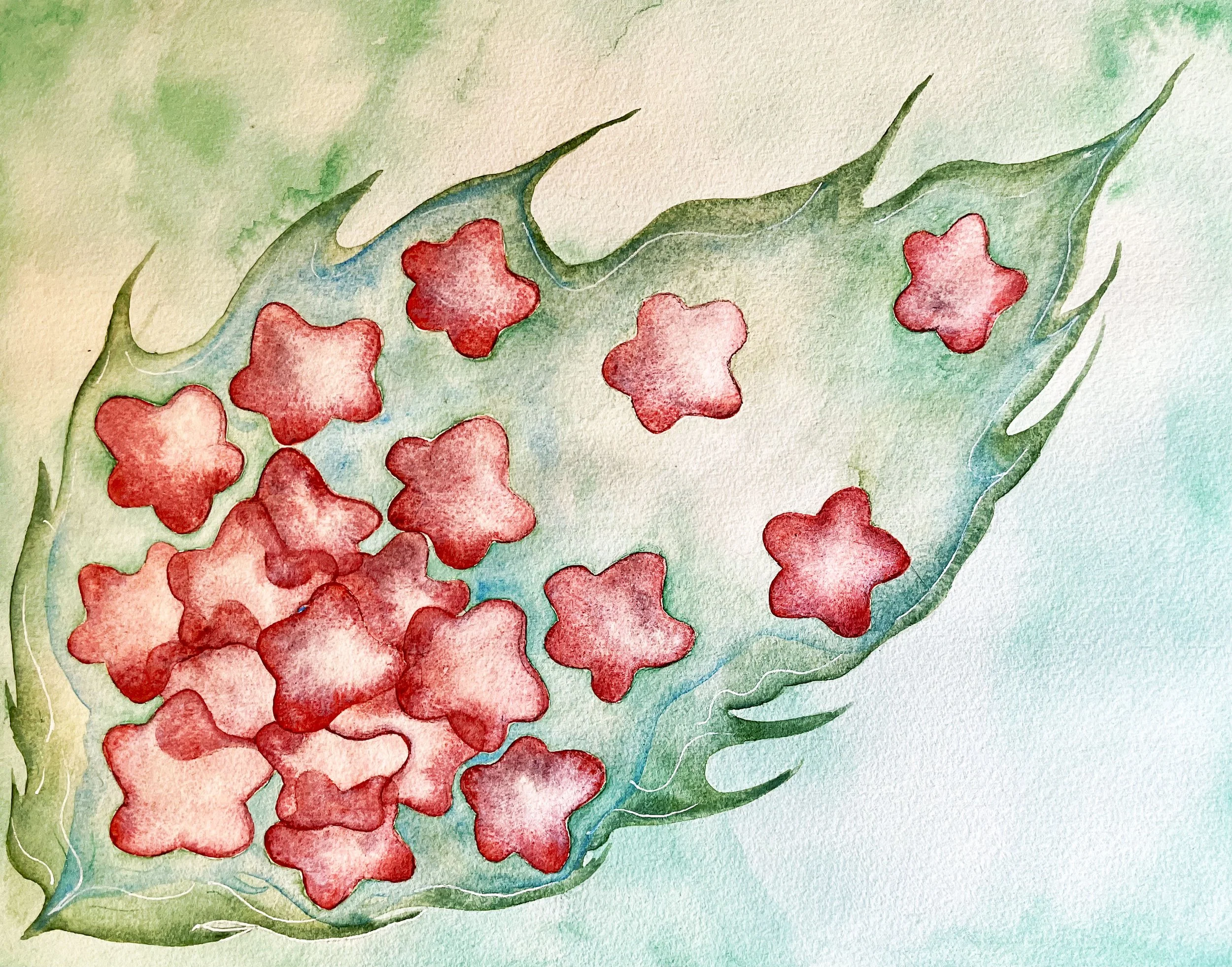
This semester, my learning has informed my personal art practice by shifting the importance to the act of making itself rather than the finished product. The ritualistic creation of radial watercolor forms removes personal blocks of what I should make, maintaining the physical process of creation without the pressure of knowing what images to produce. Emphasizing sensory and kinesthetic components, such as manipulating water and colors, minimizes personal judgements, and energy can be focused on creation.
The repetitive nature of the process has promoted a more prolific art practice, which has led me to the benefits of making more often, including slowing down, centering myself in the present moment, emotional regulation, and therefore, enjoyment. Previously, my relationship to art involved self-deprecation and negative thought spirals if I was not yielding large quantities of work because of social factors like comparison or unintentionally subscribing my art practice to capitalistic ideologies. Overcontemplating how the art would be received bypassed what the art did for me. This semester, I’ve forced myself to reshape my artistic biases in order to make my eye to see art through a therapeutic lens, which in turn has allowed me to deepen my understanding of what art making does for me at every step.
My relationship to art has benefited so much from this program because I have pushed myself to be free to make stuff unconditionally. Placing significance on process rather than product has translated as a metaphor for other areas of my life as well, as I grapple with mindfulness and being present in a culture that wants you to always be at your next destination rather than being content in the journey. I think about the privileges I have that allow me to where I can spend a couple of hours in my house painting each week, and it helps me release myself from the creative constraints I’ve struggled with. Ultimately, I just feel lucky that I get to do this. The gratitude helps me meet my practice with peace.
Art Therapy and Mindfulness
Art Therapy and Mindfulness
Jan 19
Written By Kenley Turner
For those of you who don’t know, I am in Grad School studying counseling and art therapy at Antioch University. That may be why I’ve been AFK for a bit… I’ve spent a lot of time researching the relationship between art therapy and mindfulness, and would like to self publish my foundational statement on my blog :)
DISCLAIMER: I am a STUDENT just STUDYING art therapy at the time this is published. I am not an art therapist, licensed, or practicing. ENJOY!
For those of you who don’t know, I am in Grad School studying counseling and art therapy at Antioch University. That may be why I’ve been AFK for a bit… I’ve spent a lot of time researching the relationship between art therapy and mindfulness, and would like to self publish my foundational statement on my blog :)
DISCLAIMER: I am a STUDENT just STUDYING art therapy at the time this is published. I am not an art therapist, licensed, or practicing. ENJOY!
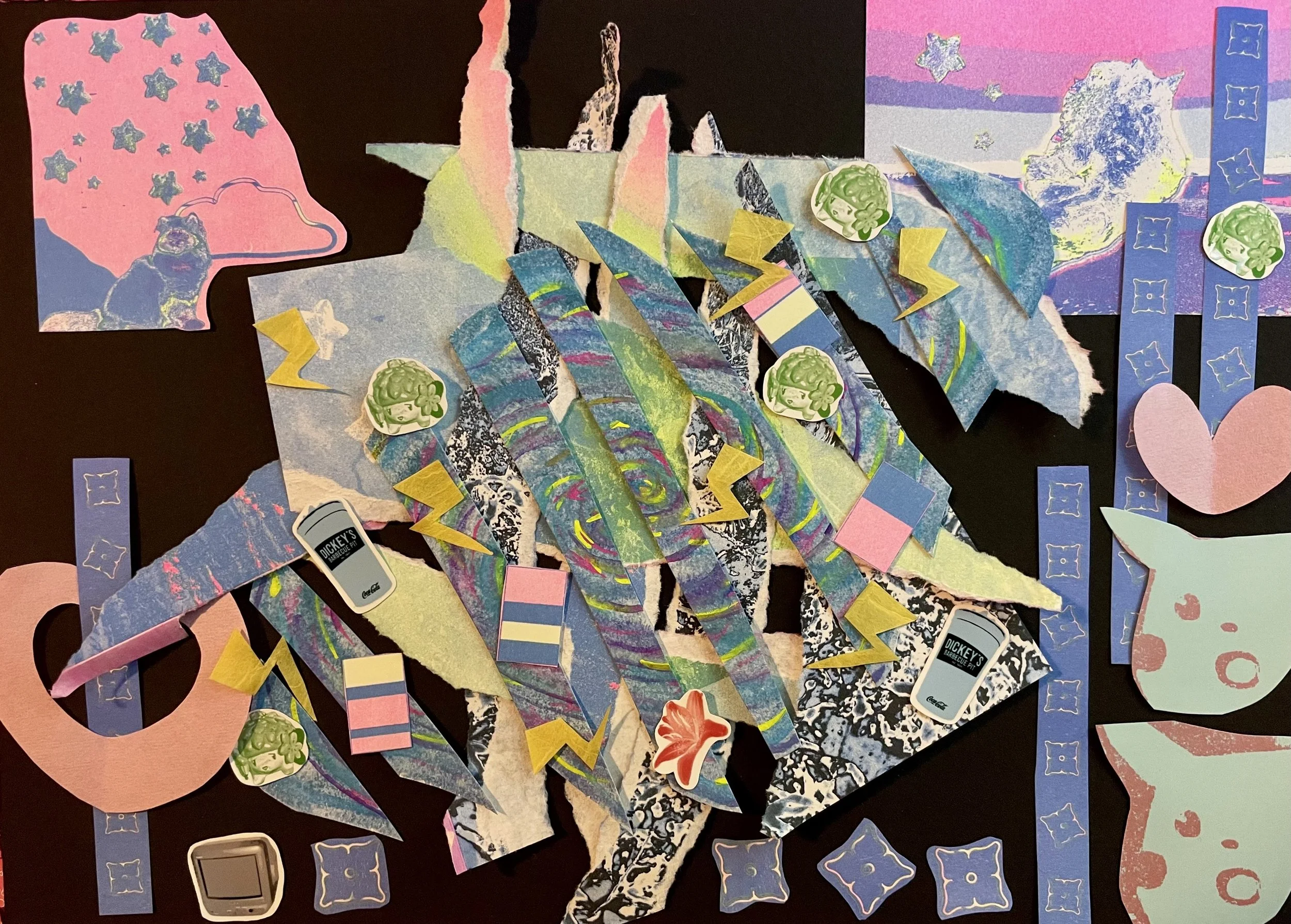
Strengths Collage, 2025
Art, Mindfulness, and Meditation
Art is important to human development and treatment because of its ability to connect an individual to their body. Activating the body and senses is often associated with obtaining a flow state often akin to meditation practices.(Clark, 2017) Engaging with the body and the environment on a purely sensory and kinesthetic level lets people take part in mindfulness, a technique that promotes well being, emotional regulation, and connecting to the present moment. (Hinz, 2019). The perceptual nature of art, such as textures, shapes, and colors help the artist obtain an acute awareness of their surroundings and experience when portraying their environment. The consciousness that the artist is able to obtain through making is a way that mindfulness and its benefits can be achieved, especially when regularly exercised.
Bringing attention to the psychosomatic link is also an integral part of many people’s healing process. Trauma’s damaging effect on the neural system has a physical outcome on the body. Kinesthetic and sensory processing channeled through art is an accessible way to deactivate the destructive brain networks aroused by traumatic experiences. (King, 2024)
Art is a visual language that is a way to convey one’s personal reality, metaphors, problem solving, and amorphous emotion. The ability to hone creativity to express these things and find externalization bring a great deal of realization for the artist to find meaning in their life. (Malchiodi, 2015) This is an ability that can be obtained by anyone, as it is intrinsic to the human experience. It is the art therapist’s job to help the artist break down social constructs that have deterred them from tapping into this ability. (Hinz, 2017) The ways in which people express and create are expanding by the day, making the world of expressive therapy to be a very expansive and exciting place to explore.
References
Clark, S. M. (2017). DBT-informed art therapy : mindfulness, cognitive behavior therapy, and the creative process. Jessica Kingsley Publishers. https://search.ebscohost.com/login.aspx?direct=true&scope=site&db=nlebk&db=nlabk&AN=1340653
Hinz, L. D. (2017). The Ethics of Art Therapy: Promoting Creativity as a Force for Positive Change. Art Therapy, 34(3), 142–145. https://doi-org.antioch.idm.oclc.org/10.1080/07421656.2017.1343073
King, J.L., & Strang, C.E. (Eds.). (2024). Art Therapy and the Neuroscience of Trauma: Theoretical and Practical Perspectives (2nd ed.). Routledge. https://doi-org.antioch.idm.oclc.org/10.4324/9781003348207
Malchiodi, Cathy A. (2015). Creative Interventions with Traumatized Children (Second edition). The Guilford Press.

Dioramas + Escapism
Excerpt on Dioramas Fantasy Workshop

Escapism is a mental diversion from unpleasant aspects of daily life, typically through activities involving imagination or entertainment. Escapism also may be used to occupy one's self away from persistent feelings of depression or general sadness.
It can be difficult to have a growth mindset. It can make it to where being contemptuous is hard. There is always something new to chase and it can make you feel like you’re on a hamster wheel and you can’t get off. I think we all have a place that we imagine ourselves going to when things are overbearing or even dull. Spending time and building that place though can take your mind off things instead of stewing in your mind is good. Creating something and putting new things into the world is good. It’s good to expand your mind build new skills and use your imagination. This is the healthiest distraction I think I can come up with.

This is student work from my Small Sculpture: Dioramas class. The work is very introspective and reflects places of memories or nostalgia for a place that they’ve never been. Being able to actually create it made it real and actualizes it for a place you can visit in your mind.


I wish these places were real, so I could go here and simply exist.